Preparing for Academic Writing & Speaking
Doing the research
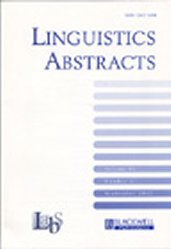
Linguistics Abstracts: Example
| Linguistics Abstracts contains abstracts in English of linguistics articles appearing in more than 140 journals from over 20 countries. Each abstract is classified and cross-classified according to area, so that it is easy to locate abstracts on a common topic. Linguistics Abstracts abstracts scholarly articles appearing in linguistics journals and selected university and laboratory working papers. It also selectively abstracts scholarly articles of linguistic interest from journals in related fields and general scientific journals. It is published 4 times per year and is also available on-line. |
Look at the following extract from Volume 19.
R Reading & Writing
| 03/R/97
Dombey, Henrietta. 2003. Interactions between teachers, children and texts in three primary classrooms in England. Journal of Early Childhood Literacy. 3 (1): 37-58. Although not legally mandatory, England’s National Literacy Strategy (NLS) has been introduced into almost every primary school in England. Interactive pedagogy and a broad conception of the reading process are claimed to permeate the various parts of the Strategy. This article examines the interactions between teachers, children and text during a Literacy Hour shared book session in three different Year 1 classrooms with five- and six-year-old children. The first transcript is taken from early demonstration video material produced by the NLS; the other two are of teachers implementing the strategy. A close examination of these transcript extracts shows very different patterns of interaction and implicit conceptions of the reading process. Paradoxically, the teacher chosen to demonstrate the Literacy Hour in action presents the most limited kind of interaction and the narrowest view of the process of reading. It is the teachers taking a more independent line who establish and support the interactive style and focus on meaning claimed by the NLS. These teachers encourage their children to develop relationships of both engagement and detachment with the texts that are the focus of attention, and thus, it is suggested, lay an important foundation for the development of complex acts of comprehension. AU 03/R/98 Hyland, Ken. 2003. Genre-based pedagogics: A social response to process. Journal of Second Language Writing. 12 (1): 17-30. Process theories have been extremely influential in the evolution of L2 writing instruction. Responding to purely formal views of writing, proponents borrowed the techniques and theories of cognitive psychology and L1 composition to refine the ways we understand and teach writing. While remaining the dominant pedagogical orthodoxy for over 30 years, however, process models have for some time found themselves under siege from more socially-oriented views of writing which reject their inherent liberal individualism. Instead, genre approaches see ways of writing as purposeful, socially situated responses to particular contexts and communities. In this paper, I discuss the importance of genre approaches to teaching L2 writing and how they complement process views by emphasising the role of language in written communication. AU 03/R/99 Kubota, Ryuko. 2003. New approaches to gender, class, and race in second language writing. Journal of Second Language Writing. 12 (1): 31-48. Gender, class, and race are constitutive elements essential to writers’ agency and identity. However, these categories are not typically paid substantial attention in second language writing as well as in the larger field of second language acquisition and bilingual development, although issues of gender have been explored to a greater extent than the other two categories. This article summarizes constructivist and poststructuralist approaches to gender discussed recently in the larger field of second language learning and applies key concepts to issues of gender, class, and race in second language writing as well as interrelations among them. Recent discussions on gender and language have problematized fixed understandings of the gender binary in relation to language use. They have explored how gendered use of language is socially and discursively constructed and how gender, language, power, and discourse are related to each other in dynamic and transformative ways. It is suggested that new approaches to gender, class, and race be dialectic in that they should both explore differences between social categories in a non-essentialist way and expose discourse and power relations that are embodied in these differences. Future research agendas on gender, class, and race in second language writing that incorporate these approaches are suggested. AU 03/R/100 Atkinson, Dwight. 2003. Writing and culture in the post-process era. Journal of Second Language Writing. 12 (1): 49-64. Does the notion of culture, currently under wide-ranging critique across the social sciences, still have a future? In this paper I discuss three possible uses of the culture concept in the field of second language writing for the 21st century: (1) Turning the cultural lens back on ourselves (where ,ourselves’ means the very academics who have found the concept most useful in the past); (2) Investigating continuity, universality, and hybridity, whereas the culture concept has traditionally been used to investigate difference, localization, and cultural ‘purity’; and (3) Expanding, contracting, and complexifying the scope of the culture concept. I conclude by arguing for a view of L2 writing that takes into account the full range of social and cultural contexts impacting L2 writing, rather than focusing narrowly on skills and processes of writing (in the classroom) in themselves. AU 03/R/101 Matsuda, Paul Kei. 2003. Process and post-process: A discursive history. Journal of Second Language Writing. 12 (1): 65-84. While the term post-process can be useful as a heuristic for expanding the scope of the field of second language writing, the uncritical adoption of this and other keywords can have serious consequences because they often oversimplify the historical complexity of the intellectual developments they describe. In order to provide a critical understanding of the term post-process in its own historical context, this article examines the history of process and post-process in composition studies, focusing on the ways in which terms such as current-traditional rhetoric, process, and post-process have contributed to the discursive construction of reality. Based on this analysis, I argue that the use of the term post-process in the context of L2 writing needs to be guided by a critical awareness of the discursive construction process. I further argue that the notion of post-process needs to be understood not as the rejection of process but as the recognition of the multiplicity of L2 writing theories and pedagogies. AU 03/11/102 Pearson Casanave, Christine. 2003. Looking ahead to more sociopolitically-oriented case study research in L2 writing scholarship: (But should it be called ‘post-process’?). Journal of Second Language Writing. 12 (1): 85-102. In this essay I argue that three familiar areas of inquiry in future L2 writing research need to be investigated in more sociopolitically-oriented ways: written products, writing processes, and writer identity, and that qualitative case studies are well suited to explore the extraordinary diversity of L2 writers and writing contexts from an expanded sociopolitical perspective. However, although substantive changes in how we think about these areas of inquiry appear to be taking place, some resistance to these changes can be expected. Finally, I suggest caution in using the label ‘post-process’ to describe the substantive changes in how we are beginning to view L2 writing scholarship. AU 03/R/103 Rubinstein-?vila Eliane. 2003. Negotiating power and redefining literacy expertise: Buddy Reading in a dual-immersion programme. Journal of Research in Reading. 26 (1): 83-97. This paper reports on a case study of face-to-face interaction around and about texts between a second grade dyad in a dual-immersion programme. Through the lenses of Vygotskian situated cognition and Literacy Studies, classroom observations were conducted, both holistic and focused. Daily peer reading sessions between a dyad were tape recorded, and informal interviews with the teacher and the participating dyad were conducted. The analysis of participants’ verbal exchanges revealed multiple pedagogical scaffolds, few of which were unexpected. As meaning making became more salient to the various collaborative literacy tasks, the roles of tutor and tutee were blurred. The shift in power also impacted the direction of language switches. Buddy Reading encouraged the peer readers to acknowledge and draw upon each other’s expertise, as they redefined what it meant to be ‘a good reader’. AU 03/11/104 Petric, Bojana. 2003. Validating a writing strategy questionnaire. System. 31 (2): 187-216. Validation of data collection instruments is an extremely important step in research; however, it is often only briefly reported in research studies. This paper deals with the validation of a writing strategies questionnaire and presents the various stages in the validation process. The questionnaire was validated using a qualitative and a quantitative method with two groups of participants from the target population, i.e. advanced non-native speakers of English. Using the qualitative and quantitative data, the authors discuss factors which affected the participants’ responses to the questionnaire, dividing them into factors related to the construct of writing strategies, and those related to the research instrument and reliability check method. Potential problems and limitations of research into writing strategies using questionnaires are pointed out. The authors conclude that validation using triangulation of different data sources provides not only information on the validity of the instrument but also valuable insights into the construct itself. AU |
03/11/104
Cz?rl, Bernadett. 2003. Validating a writing strategy questionnaire. System. 31 (2): 187-216. Validation of data collection instruments is an extremely important step in research; however, it is often only briefly reported in research studies. This paper deals with the validation of a writing strategies questionnaire and presents the various stages in the validation process. The questionnaire was validated using a qualitative and a quantitative method with two groups of participants from the target population, i.e. advanced non-native speakers of English. Using the qualitative and quantitative data, the authors discuss factors which affected the participants’ responses to the questionnaire, dividing them into factors related to the construct of writing strategies, and those related to the research instrument and reliability check method. Potential problems and limitations of research into writing strategies using questionnaires are pointed out. The authors conclude that validation using triangulation of different data sources provides not only information on the validity of the instrument but also valuable insights into the construct itself. AU 03/11/105 Hyland, Fiona. 2003. Focusing on form: Student engagement with teacher feedback. System. 31 (2): 217-230. This paper explores the relationship between teacher feedback and student revision in two academic writing classes. The study adopts a case study approach and looks at all the feedback given to six students over a complete course. Using data from teacher think aloud protocols, teacher and student interviews and student texts, it examines the extent to which teachers focused on formal language concerns when they gave feedback and the use that students made of this feedback in their revisions. Findings suggest that despite the teachers’ beliefs and teaching approaches, language accuracy was a very important focus for their feedback. While most of the students engaged with this feedback when revising their drafts, the extent to which they used it varied among the case study subjects. Two case studies who made consistent and sustained use of form-focused feedback are discussed in greater detail to examine student engagement with form-focused feedback over a complete course. AU 03/11/106 Ozono, Shuichi and Harumi Ito. 2003. Logical connectives as catalysts for interactive L2 reading. System. 31 (2): 283-298. The present paper focuses on logical connectives as catalysts for interactive reading. Its basic purpose is to clarify how text comprehension can be affected by the types of logical relations and by the levels of proficiency in English (L2), using Japanese university students as the subjects for experimentation and focusing on three logical connectives; forexample for illustrative, therefore for causal ;and however for adversative. A special test (Logical Relations Reading Test) was developed, in which the subjects were asked to select appropriate logical connectives for the target logical relations. The results show that the low proficiency group’s performance varied from one type of logical relation to another while the high proficiency group were little affected by the type of logical relations in their reading performance. Also shown is that the low group had a tendency to favour for example over therefore, and therefore over however while the high group had a tendency to select each of the three logical connectives evenly. Based on these findings, a concept of cognitive load is proposed as an additional factor causing the difference in performance among readers of different L2 proficiency levels, thus supplementing Murray’s continuity hypothesis. AU 03/R/107 Stanovich, Keith E. 2003. Understanding the styles of science in the study of reading. Scientific Studies of Reading. 7 (2): 105-126. Remarkable progress has been made in the last 30 years toward understanding the basic psychological processes that underlie the act of reading. Dissemination of these results has sometimes been hampered because they are associated with strong stances on 5 different dimensions that represent styles of doing science. Research into the psychology of reading has been characterized by an emphasis on correspondence theories of truth rather than coherence, an emphasis on analytic reductionism rather than holism, an emphasis on probabilistic prediction (as opposed to a case-based approach), the search for robust-process explanations (rather than actual-sequence explanations), and a concern for consilience. These scientific styles have served the field well to this point, but that does not mean that we have calibrated their use in the optimal manner. Critiques by those with differing scientific styles may help the field to adjust its stance on these style dimensions in ways that foster scientific progress. This article ends with some thoughts on the difficulty of defining the scientific method. AU 03/R/108 Wang, Min, Charles A. Perfetti and Ying Liu. 2003. Alphabetic readers quickly acquire orthographic structure in learning to read Chinese. Scientific Studies of Reading. 7 (2): 183-208. This study aimed to explore how alphabetic readers learn to read Chinese. Firstyear Chinese beginning learners who are skilled English readers were tested for their sensitivity to the visual-orthographic structures of Chinese characters. The study also explored the effect of the frequency of the characters in their curriculum on performance of a lexical decision and naming task. The students’ linguistic knowledge about the characters was also tested. Results showed that the beginning learners were sensitive to the structural complexity of characters, they accepted simple characters more quickly and more accurately than compound characters, and they responded faster and more accurately to high-frequency than to low-frequency characters. Sensitivity to the structural composition of the character was also revealed: The learners rejected noncharacters containing illegal radical forms faster and more accurately than those containing legal radical forms in illegal positions, which in turn were rejected faster and more accurately than those containing legal radical forms in legal positions. A significant frequency effect was also found in the naming task, though the effect of structural complexity was not significant. These results suggest that perceptual learning plays an important role in early nonalphabetic learning by alphabetic readers. Both cross-writing system differences and second-language status may have an impact on such learning. AU 03/R/109 Fahnestock, Jeanne. 2003. Verbal and visual parallelism. Written Communication. 20 (2): 123-152. This study investigates the practice of presenting multiple supporting examples in parallel form. The elements of parallelism and its use in argument were first illustrated by Aristotle. Although real texts may depart from the ideal form for presenting multiple examples, rhetorical theory offers a rationale for minimal, parallel presentation. The form for presenting data can also influence the way it is observed and selected, as the case of the Linnaean template for species grouping illustrates. Parallel presentation is not limited to verbal phrasing. Arranging data in tables, typical in scientific discourse, satisfies the same requirements for minimal, equivalent presentation of evidence. Arranging representational or iconic images in rows or arrays is yet another mode for the parallel presentation of evidence, although this mode has a recent history. A cognitive rationale can perhaps explain the use of parallelism to present multiple supporting examples. AU 03/11/1 10 Markelis, Daiva. 2003. ‘Talking through letters’: Collaborative writing in early Lithuanian immigrant life. Written Communication. 20 (2): 153-169. The emphasis on the individual in Western culture has blinded us to how social relationships affect literacy acquisition and, conversely, how literacy transforms these relationships. This article deals with the literacy practices, specifically, letter writing, of Lithuanian immigrants who arrived in the United States during the end of the 19th century. For these immigrants, reading and writing were collaborative activities, not the individual, solitary acts that we often assume them naturally to be. Individuals often turned to more literate neighbors for assistance in tasks involving reading and writing, an extension of the concept of talka, the Lithuanian tradition of collective assistance. Parents also frequently engaged the help of sons and, especially, daughters in writing letters to relatives in Lithuania. Letter writing thus not only fostered solidarity between immigrant and their relatives in Lithuania but also between Lithuanian immigrant parents and their increasingly literate, Americanized children. AU 03/R/111 Cahill, David. 2003. The myth of the ‘turn’ in contrastive rhetoric. Written Communication. 20 (3): 170-194. Contrastive rhetoric scholarship researches rhetorical structures across languages to predict the difficulties experienced by students learning to write essays in a second language. The paradigmatic contrast is between Western languages (e.g., English) that are said to exemplify ‘linearity’ and ‘directness’ and Eastern languages (e.g., Chinese, Japanese) that are said to exemplify ‘nonlinearity’ and ‘indirectness.’ The prime examples in English-language contrastive rhetoric scholarship of Asian essay structure are the four-part Chinese qi cheng zhuan he and Japanese ki sho ten ketsu, whose third steps are said to represent a ‘turn’. The author’s research into Chinese and Japanese-language scholarship on these two structures fords that the ‘turn’ is not a rhetorical move of ‘circularity’ or ‘digression’ as commonly assumed but rather serves as the occasion to develop an essay further by alternative means. The implication for second-language writing is recognition of greater similarities in essayist literacy across these languages than previously supposed. AU |
Find the abstracting journals for your subject.
Linguistics Abstracts: List of periodicals
Abstracting journals will give you a list of the journals used to compile the abstracts. This is the list from Linguistics Abstracts.
Acquisition et Interaction en Langue ?trang?re
Acta Linguistica Hungarica
American Journal of Philology
American Speech
Annual Review of Applied Linguistics
Annual Review of Language Acquisition
Anthropological Linguistics
Antwerp Papers in Linguistics
Aphasiology
Applied Linguistics
Applied Psycholinguistics
Archiv orientaln?
Artificial Intelligence Review
Artificial Intelligence
Asia Pacific Journal of Speech, Language and Hearing
Asian Journal of English Language Teaching
Assessing Writing
Augmentative and Alternative Communication
Australian Journal of Linguistics
Australian Review of Applied Linguistics
Babel
Balkanistica
Bilingualism
Canadian Journal of Applied Linguistics, The
Canadian Modern Language Review, The
Canadian Slovanic Papers
Child Development
Child Language Teaching and Therapy
Cognition
Cognitive Neuropsychology
Cognitive Systems Research
Computational Intelligence
Computational Linguistics
Computer Assisted Language Learning
Computers and Composition
Computers and the Humanities
Contrastive Linguistics
Diachronica
Discourse & Society
Document Design
English for Specific Purposes
English Language and Linguistics
English Linguistics
English Studies
English Today
English World-Wide
Eoneohag
EUROSLA Yearbook
Field Methods
First Language
Functions of Language
General Linguistics
Gesture
Glottometrics
GOVOR
Grammars
Hebrew Linguistics
Histoire ?pist?molgie Langage
Historiographia Linguistica
Information Design Journal
Interdisciplinary Journal for Germanic Linguistics & Semiotic Analysis
International Journal for the Semiotics of Law
International Journal of American Linguistics
International Journal of Applied Linguistics
International Journal of Bilingual Education and Bilingualism
International Journal of Bilingualism
International Journal of Corpus Linguistics
International Journal of Lexicography
International Journal of the Sociology of Language
Interpreting
Jezik
Journal of Asian Pacific Communication
Journal of Celtic Linguistics
Journal of Child Language
Journal of Chinese Linguistics
Journal of Communication Disorders
Journal of Comparative Germanic Linguistics, The
Journal of Early Childhood Literacy
Journal of East Asian Linguistics
Journal of English for Academic Purposes
Journal of English Linguistics
Journal of Fluency Disorders
Journal of Germanic Linguistics
Journal of Greek Linguistics
Journal of Historical Pragmatics
Journal of Indo-European Studies, The
Journal of Language and Politics
Journal of Language and Social Psychology
Journal of Linguistics
Journal of Logic, Language and Information
Journal of Memory and Language
Journal of Multilingual and Multicultural Development
Journal of Neurolinguistics
Journal of Phonetics
Journal of Pidgin and Creole Languages
Journal of Portuguese Linguistics
Journal of Pragmatics
Journal of Psycholinguistic Research
Journal of Quantitative Linguistics
Journal of Research in Reading
Journal of Second Language Writing
Journal of Semantics
Journal of Sociolinguistics
Journal of the Acoustical Society of America, The
Journal of the Phonetic Society of Japan
Journal of the Simplified Spelling Society
Journal of Universal Language
Juznoslovenski filolog
Kokugogaku
Language & Communication
Language Acquisition
Language and Cognitive Processes
Language and Education
Language and Intercultural Communication
Language and Learning
Language and Literature
Language and Speech
Language Awareness
Language Culture and Curriculum
Language in Society
Language Learning
Language Policy
Language Problems & Language Planning
Language Research
Language Sciences
Language Teaching Research
Language Testing
Language Variation and Change
Language
Language, Culture and Curriculum
Laterality
Lingua
Linguistic Discovery
Linguistic Inquiry
Linguistic Review, The
Linguistics and Philosophy
Lingvistic? Investigationes
Literary & Linguistic Computing
Literary and Linguistic Computing
Lund University Working Papers
Machine Translation
Measurement
Metaphor and Symbol
Mind & Language
Modern Language Journal, The
Multilingua
Narrative Inquiry
Natural Language & Linguistic Theory
Natural Language Engineering
Norsk Lingvistisk Tidsskrift
Oceanic Linguistics
Philologie im Netz
Phonetica
Phonology
Pragmatics
Prague Bulletin of Mathematical Linguistics, The
Proceedings of Japanese Cognitive Linguistics Association
Proceedings of the First Annual Meeting of the Japanese Cognitive Linguistics Association
Proceedings of the Second Annual Meeting of the Japanese Cognitive Linguistics Association
Przeglad Rusycystyczny
Quarterly Journal of Experimental Psychology, The
Rasprave Instituta Za Hrvatski Jezik I Jezikoslovlje
Reading and Writing
Reading Literacy and Language
Reading
RELC Journal
Research on Language and Social Interaction
Revista de Documentação de Estudos em Linguistica Teórica e Aplicada
Russian Linguistics
Science
Scientific Studies of Reading
Second Language Research
Sign Language & Linguistics
Sign Language Studies
Sintagma
SKY Journal of Linguistics
Slavisticna revija
Social Semiotics
Southern African Linguistics and Applied Language Studies
Speech Communication
Sprachtypologie and Universalienforschung
Stellenbosch Papers in Linguistics
Strani jezici
Studia Linguistica
Studia Logica
Studies in Communication Sciences
Studies in Language
Studies in Second Language Acquisition
Syntax in the Schools
Syntax
System
Target
Terminology
TEXT
Theoretical and Applied Linguistics at Kobe Shoin
Theoretical Linguistics
Transactions of the Philological Society
Turkic Languages
Visual Communication
WORD
World Englishes
Written Communication
Written Language & Literacy
Zeitschrift fur Sprachwissenschaft
