THE ODOR-MAKERS
The truth about why and how we smell is still shrouded in mystery. How does
the nose do its work? What makes some smells delightful and others repulsive?
These are questions that scientists are working on.
One theory has it that pleasant smells are made up of a great number of different
chemical compounds. Laboratory analysis of roses, for example, shows that the
scent is produced by 20 or more ingredients; the aroma of coffee is the end
result of at least 35. Bad smells, on the other hand, tend to be rather simple.
They are too crude for our taste. That may be why we do not like them.
Chemists do not let the lack of understanding of the causes of smells hold
them back. They continue mixing and blending compounds that smell good, even
if they are not sure of the reasons.
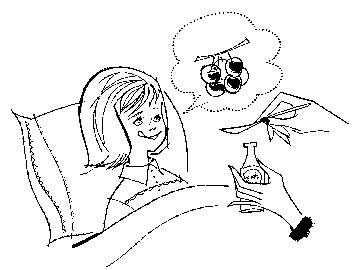
 The
men who specialize in creating odors in the laboratory must have exceptionally
keen senses of smell. They are known in this business as "the noses,"
or sometimes as "the long noses," and they train themselves to recognize
a tremendous number of different odors. A whiff of perfume is in the air; they
instantly identify the scents that have gone into it - lemon, tweed, eucalyptus,
sandalwood. A good odor chemist can recognize about 4,000 different smells.
Some can do even better than that. One chemist claims that he can spot 7,000.
The
men who specialize in creating odors in the laboratory must have exceptionally
keen senses of smell. They are known in this business as "the noses,"
or sometimes as "the long noses," and they train themselves to recognize
a tremendous number of different odors. A whiff of perfume is in the air; they
instantly identify the scents that have gone into it - lemon, tweed, eucalyptus,
sandalwood. A good odor chemist can recognize about 4,000 different smells.
Some can do even better than that. One chemist claims that he can spot 7,000.
In the laboratory the scientist sits at what has been described as a "perfumer's
organ." Instead of the keyboard, he has row upon row of flasks ranged in
front of him, each containing a different scent. A typical "kit" has
some 600 or 700 ingredients in it. These are combined until the right effect
is produced.
Not all "artificial" odors are made from synthetic products. Natural
oils and extracts are often used. Some of the "wood" smells added
to plastic "wood," for example, contain at least a little of an extract
made from bark. The end result still deserves to be called artificial, because
it does not smell the way nature intended.
"Any smell from a rose to rhinoceros hide can be reproduced in the laboratory,"
says a chemist confidently. The oil is taken from the flower; an extract is
made from leather or rubber by dissolving it. What chemicals have combined in
nature to produce each smell? The "nose" takes the essence or extract
and puts a few drops on a small white square of blotter. He smells it, lets
it dry, and sniffs again. Then he tries to figure out which chemicals are responsible
for the odor. A series of laboratory tests pick up those compounds which the
"nose" may have missed.
Identifying the chemicals is only the beginning. In what order were they
combined in nature? How much of each is needed? Nobody knows exactly when a
rose begins to smell like a rose. The scientist can only try to repeat the process
by a system of trial and error. He puts the chemicals together in one way, and
then in another ... tries a little more of this and a little less of that .
. . until at last the familiar smell of the lily or the orange rises from his
flask.
How does he know he is right? No two people have the same sense of smell.
One chemist tells how he developed what he thought was a perfect imitation grass
smell, only to have a friend say cheerfully: "Ah, buckwheat cakes!"
The opinion of the majority has to rule. The perfumer takes the natural product
and his duplicate of it around the laboratory, and asks his co-workers to sniff
it. If they agree that the artificial smells like the natural product - and
the right natural product - it goes on for additional tests. A "smell panel"
of men and women is called in and asked for an opinion. Once in awhile a public-opinion
survey is held.
You may wonder why the chemist tries so hard to copy the odor of a rose or
lily of the valley when these flowers are grown in many gardens. Strange as
it seems, it is easier and cheaper to make perfume out of chemicals than out
of natural products. Oil of violet is used in many perfumes. It takes 66 million
violets to make only one pound of this fragrance. This is why scientists were
so proud of reproducing the smell.
Sometimes the chemist is told to create a completely new odor. In these cases
he does not need to copy nature, but he must make something that smells good.
"Deciding whether a new scent is good is a tricky business," complains
a chemist. "You love the odor of gardenias; your sister hates it. Neither
of you can say why."
Even when the fragrance wins the approval of the majority, the perfumer cannot
bring his research to a halt. The synthetic smell may not behave well. Perhaps
it vanishes into thin air so quickly as to be quite useless. The passage of
time may change the flower into a fish. In addition, many fragrances are planned
for a specific use. An imitation pine smell is needed for an artificial Christmas
tree. It is not enough for it to smell good on a square of blotter; the fragrance
must not get lost in the odor of plastic. A tweedy aroma is to be added to a
dress fabric.
The scientist must take to his washtub to discover what happens after the
garment is washed once, twice, fifty times. The chemist must also find out whether
the essence works best dissolved in water or in alcohol, or when soaked into
a ceramic block.
Copying natural odors, making new aromas and deciding how to use them, are
only part of the smell maker's work. You have read in an earlier chapter about
the importance of "deodorizing" and "reodorizing." How is
this done? The most common way is to add a strong, pleasant smell which covers
up or "masks" the bad one. The name given to the process is, therefore,
"masking." Pine, wintergreen, sassafras and citronella are just a
few of the strong odors capable of conquering weaker ones. The scents which
are used in this way are called "masking agents."
Not all odor control, however, is based on this coverup technique. Some aromatic
chemicals work on the principle best described in the slangy expression, "if
you can't lick 'em, join 'em." They combine physically with the chemicals
that produce the bad odors. The structure of those compounds is completely changed.
In this way a new odor is created.
"Mixing smells is very similar to blending colors," explains a
research chemist at Rhodia, one of the major firms working in this field. "If
you add yellow to an ugly shade of blue you will not get a pretty shade of blue,
you will get green. Similarly, if you add a good smell to a bad one you can
get a pleasant smell that is quite different from both. Another possibility
is for the two to knock each other out and leave no smell at all."
As agreeable odors are complicated compared to the simpler bad ones, the
masking agent usually contains anywhere from 10 to 126 different ingredients.
Thirty is considered typical.
"Each masking agent must be custom made," states an industrial
chemist. "The aromatic chemical that conquers natural rubber's foul smell
can be quite helpless against the vinyl plastic in a shower curtain. And changing
the smell can lead to some unpleasant side effects, as any chemical - even a
perfume - reacts with another."
One chemist tried putting a minty odor into the "bath" of chemicals
in which a fabric was soaking. The idea was to replace the fishy odors described
before. The new fragrance did win out, but the material was no longer shrinkproof.
The problem is to find a chemical that does not have a bad effect on any of
the other chemicals in the "bath." The material has to smell good
and still be drip dry, water resistant, shrinkproof, color fast and crease resistant.
The problems involved in controlling the terrible smells released into the
air by industrial plants are even harder to solve. The first step is the discovery
of just what gases are to blame for the stench. The "noses" must play
detective. In a city in Texas not long ago passers-by were surprised to see
a man standing outside a factory and sniffing the foul air with all the enthusiasm
of a sailor at the ocean's edge. It was an odor chemist doing his homework.
Can this be sulfur? Or ammonia? Or nitrogen? When he had identified the ingredients
he went back to the laboratory and got to work blending a similar concoction.
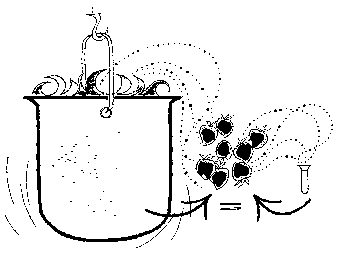
 "We
first try to figure out just how strong the bad smell really is," declares
a research chemist. "We dilute the chemicals responsible for the smell
until we hit on a concentration that seems just about the same as the one at
the factory. The masking agent we design has to be at least that strong if it
is to have any effect."
"We
first try to figure out just how strong the bad smell really is," declares
a research chemist. "We dilute the chemicals responsible for the smell
until we hit on a concentration that seems just about the same as the one at
the factory. The masking agent we design has to be at least that strong if it
is to have any effect."
Every ingredient that goes into the "mask" is matched to a chemical
in the bad smell. Some of these compounds boil faster than others. As a result,
they enter the atmosphere at different moments. Laboratory tests give the chemists
a timetable. They find good-smelling chemicals which perform in the same way
as the ones they are to attack. The masking agent is like a team of fighters.
As each bad-smelling compound boils and enters the air a fragrant compound boils,
too, and knocks it out ... until no unpleasant odor remains.
Achieving this happy result is just as difficult as it sounds. More than
200 compounds, many of them made up of over 25 ingredients, were tested before
one was found that successfully concealed the exhaust fumes produced by diesel
fuel.
"We have yet another way of controlling odors," reports an industrial
chemist. "We force the compounds that produce bad smells to break down
and destroy themselves. This is done by adding chemicals that cause this type
of reaction."
Chemicals can be used to make hydrogen sulfide come apart before it ever
has a chance to get into the air and fill the atmosphere with the odor of rotten
eggs. This method has already been tried at a number of paper mills and oil
refineries.
You may by now be wondering why anything should smell bad when it is possible
to perfume every product you use, the air around you and the atmosphere surrounding
factories and garbage dumps. Cost is the big stumbling block. A paper mill,
for example, must make good paper if it is to stay in business. The fact that
sulfur gases are released into the air when pulp is made has nothing to do with
the sales of finished paper. This is one of the unfortunate facts of business
life. Only one out of every ten paper mills uses an effective system of odor
control today.
There is every reason to hope that tomorrow will be better, as one industry
after another enters the fight against unpleasant aromas. This is only the dawn
of the chemical age. You will have to be patient in waiting for the day when
a bad smell will become no more than a bad memory.
(From The artificial world around us, by Lucy Kavaler)